Ion identity networking
Feature list methods → Feature grouping → Ion identity networking
Annotates grouped features (same retention time and, optionally, feature shape and height correlation) as ion adducts, in-source fragments, and multimers. All feature pairs within a correlation group are searched against an ion library: whenever two rows resolve to the same neutral mass under two ion types of the library, an ion identity is assigned and both rows join the same ion identity network.
Ion identities are the basis of the Ion Identity Molecular Networking (IIMN) workflow in mzmine:
run this module and then
Spectral / Molecular Networking, which combines
the ion identity networks with MS2 fragmentation similarity into one network. The resulting
networks can be explored in mzmine's
interactive network visualizer
and exported to .graphml.
Warning
Apply Correlation grouping (metaCorrelate) before running this module.
Recommended citations
Info
When using this modules, please consider citing the corresponding publication(s):
Schmid, R., Petras, D., Nothias, LF. et al. Ion identity molecular networking for mass
spectrometry-based metabolomics in the GNPS environment. Nat Commun 12, 3832 (
2021). https://doi.org/10.1038/s41467-021-23953-9
Schmid R., Heuckeroth S., Korf A., et al. Integrative analysis of multimodal mass spectrometry data in MZmine 3, In Review (2023)
Parameters
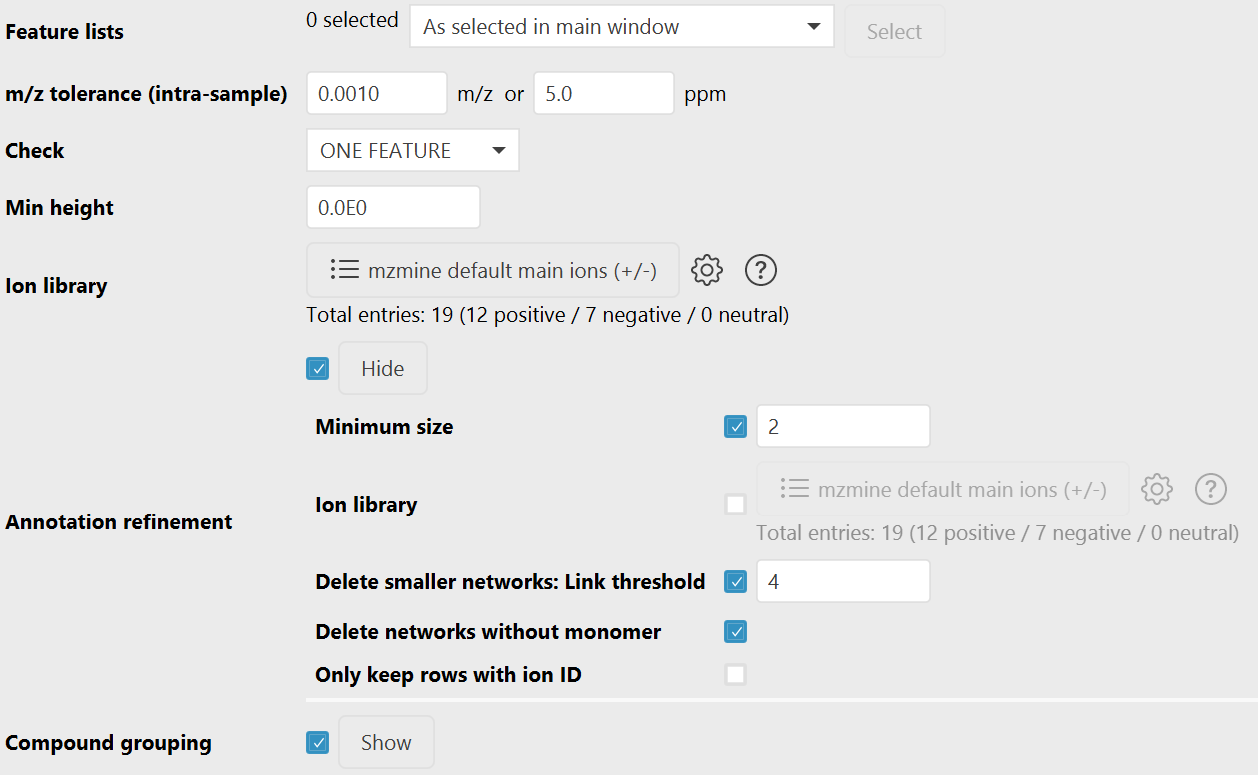
m/z tolerance
Intra sample m/z tolerance describes the difference between two ions of the same molecule at the same retention time. This tolerance is usually very small and depends on the mass resolution. Orbitrap instruments for example 3 ppm.
Check
- ONE FEATURE: Only one feature needs to match (m/z difference within one sample)
- ALL FEATURES: All features need to match (m/z difference within ALL samples)
- AVERAGE: Matches the m/z difference of average values
Min height
Minimum height of features to consider. Leave at 0 to use all features that passed the feature detection workflow criteria.
Ion library
The full list of ions to search: adducts, in-source fragments, multimers, and clusters. When two features, annotated with two of these ion types, result in the same neutral mass, an ion identity is assigned.
The default is mzmine default comprehensive (+/-). Select a different library, or create your own, as described in Ion types & libraries. Only ion types matching the polarity and charge state of a row are used for that row, so a dual-polarity library is safe to use for data of a single polarity.
Tip
This step should only focus on the main ions that are typically detected in the MS method. Later, the Add ion identities to networks module can add rarer ions to existing networks.
Annotation refinement (optional)
Annotation refinement is optional but should be applied to finalize ion identities, after all subsequent optional steps of Add ion identities to networks.
Parameters:
- Minimum size (optional): Only retain ion networks with at least n ions (often 3). The more ions the higher the confidence in the annotation.
- Ion library (optional): The library of main ions, i.e., ions that are well expected in this analysis. Each final ion identity network must contain at least one of them. While unchecked, the internal mzmine default main ions (+/-) library is used.
- Delete smaller networks: Link threshold (optional): Important parameter to only keep the best annotation, when this annotation is supported by n-1 ions (network size n).
- Delete networks without monomer: Only keep a network if at least one ion is M+... and not only multimers like 2M, 3M...
- Only keep rows with ion ID: Remove all rows from the feature list that have no ion identity annotation.
Compound grouping (optional)
Directly creates a compounds list from this feature list, where the correlated rows and their ion identities are grouped into compound rows. The same step is also available as the separate Compound grouping module. And is usually applied after all steps including any annotation steps for better results.